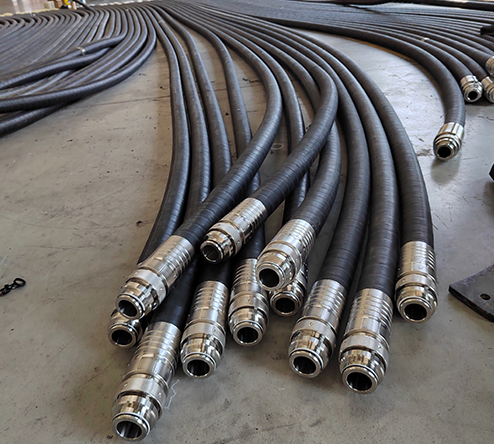
Hydraulic technology is ubiquitous across industries, but the requirements for hydraulic hoses vary drastically from sector to sector. General-purpose solutions cannot meet all needs; a deep understanding of the specific challenges of each industry is essential to providing truly reliable and efficient customized solutions. This article will delve into the extreme requirements for hydraulic hoses in three representative sectors.
Key Challenges:
Extreme Dynamic Bending: The hoses on the excavator boom constantly bend and oscillate with the bucket’s movement, demanding extremely high pulse fatigue life.
Severe External Wear: The hoses inevitably rub and collide with soil, gravel, and structural components.
Wide Temperature Range Operation: From the frigid winters of the north to the scorching heat of the desert, stable material properties are required.
Trend Towards Higher Pressure: To increase power density, system pressures have evolved from the traditional 25MPa to 35MPa and even higher.
Solutions:
Hose Selection: Main pressure lines commonly use SAE 100R12/13/15 (4/6 layers of wire braid) or equivalent ultra-high pressure, high-pulse hoses. Pilot lines can use SAE 100R7 thermoplastic tubing to reduce weight.
External Protection: Standard spring sheaths and abrasion-resistant nylon sleeves protect the hoses from mechanical damage. Friction points are avoided as much as possible during hose installation.
Materials Technology: Utilizes an ozone-resistant and weather-resistant synthetic outer layer (such as CR), while the inner layer employs HNBR to withstand higher temperatures.
Joint Technology: Extensive use of Ortho-Flat Sealing Joints (ORFS), which offer significantly higher shock resistance, anti-loosening properties, and sealing reliability than threaded joints.
II. Aerospace: The Art of Balancing Lightweight Design, High Reliability, and Extreme Environments
The hydraulic systems of aircraft and rockets are critical to flight safety, demanding the highest standards of industrial application.
Core Challenges:
Extreme Lightweighting: Reducing every gram of weight is crucial for fuel economy and payload.
Ultra-High Reliability: Failures have catastrophic consequences; extremely low failure rates are required.
Extreme Temperatures: From 60°C at ground level to -55°C at altitudes of 10,000 meters.
Flame Retardant Requirements: Self-extinguishing materials must be used to prevent fires.
Solutions:
Material Revolution: Widespread use of polyamide (PA11/PA12) thermoplastic hoses. These are 30%-50% lighter than comparable rubber hoses, have longer pulse life, and feature a smooth inner wall with low resistance.
High Standards: Adherence to stringent AS (Aerospace Standard) and MS (Military Standard) standards, with end-to-end quality control from materials to manufacturing processes.
Sealing Technology: Utilizing metal seals or advanced composite seals ensures absolutely reliable sealing even under drastic temperature changes.
Fire-Resistant Design: The hose is covered with a stainless steel braided sheath, providing both lightweight protection and meeting fire safety requirements.
III. Marine Equipment: A Fortress Against Corrosion, High Pressure, and Deep-Sea Environments
From shipboard deck machinery to deep-sea exploration robots, the marine environment poses unique threats to hydraulic systems.
Core Challenges:
Overall Corrosion: Salt spray and seawater are extremely corrosive to hose fittings and reinforcement layers.
High-Pressure Environment: Deep-sea equipment is subjected to extremely high hydrostatic pressure (one atmosphere per 10 meters of water depth), requiring hoses to withstand compression.
Space Constraints: The compact space in ship engine rooms necessitates compact hoses with excellent flexibility.
Solutions:
Material Selection: The outer rubber layer must be made of neoprene (CR), whose superior resistance to salt spray and seawater is the only option. Fittings must be made of 316/316L stainless steel.
Compression-Resistant Design: Hoses used in deep-sea equipment must have an additional compression-resistant layer, typically composed of spirally wound plastic or metal strips, to prevent collapse under external water pressure.
Certification Requirements: Hose must be certified by a classification society such as DNV GL, ABS (American Bureau of Shipping), or CCS (China Classification Society) to prove its suitability for marine environments.
Cleanliness: For marine equipment used in fisheries or food processing, hose materials must be non-toxic, odorless, and meet food-grade or environmental protection requirements.
These three case studies clearly demonstrate that selecting hydraulic hoses is a highly customized process. Successful selection begins with a deep understanding of the application scenario and culminates in the precise application of materials, standards, and certification technologies. Only in this way can hydraulic systems operate smoothly under various extreme challenges.