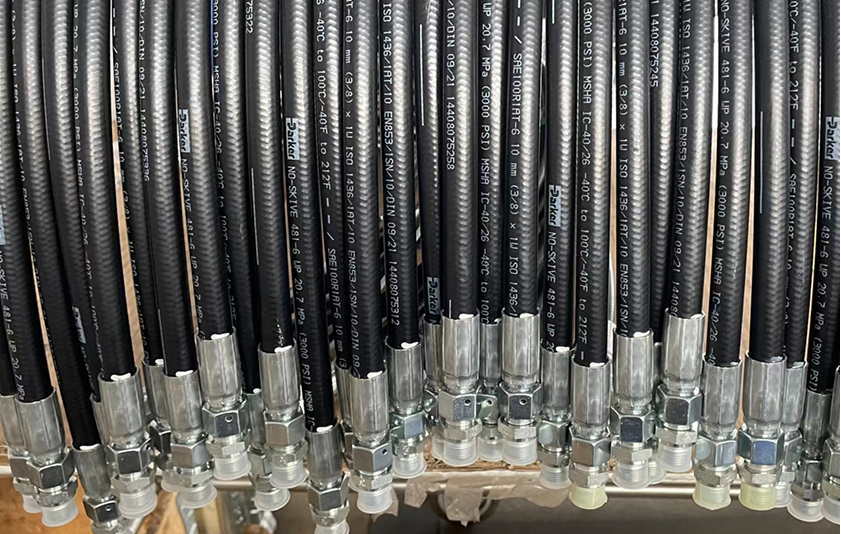
Technical Specifications for Rubber Hose in Hydraulic Transmission Systems of Agricultural Machinery
The unique working environment of agricultural machinery places specific demands on hydraulic hoses. This article will systematically analyze the challenges and solutions faced by hydraulic hoses in agricultural equipment such as tractors and combine harvesters.
Compared to industrial environments, agricultural machinery hydraulic systems face more complex operating conditions: long-term idleness due to seasonal use, dust pollution during field operations, chemical corrosion, and large diurnal temperature variations. These factors necessitate that agricultural hydraulic hoses possess stronger environmental adaptability.
Weather resistance is the primary consideration for agricultural hydraulic hoses. Studies show that ordinary rubber hoses exposed to ultraviolet light can have their service life shortened by 30-50%. Therefore, high-quality agricultural hydraulic hoses typically have UV-resistant components added to the outer layer or use special formulations such as EPDM (ethylene propylene diene monomer rubber), a material that maintains good elasticity within a temperature range of -40℃ to +120℃, making it particularly suitable for agricultural environments with large temperature differences.
Anti-contamination capability is equally crucial. Agricultural hydraulic oil often contains moisture, microorganisms, and particulate contaminants, requiring the inner layer of the hose to have excellent hydrolysis and microbial resistance. Test data from an international agricultural machinery manufacturer shows that hydraulic hoses with a special lining formula have a service life 2-3 times longer in contaminated oil than conventional hoses.
In terms of structural design, agricultural hydraulic hoses typically employ:
Compact steel wire braided layers (2-4 layers) balance pressure requirements with flexibility.
Thickened outer rubber layer (typically ≥2mm) resists mechanical damage.
Spiral steel wire reinforcement prevents negative pressure from collapsing.
For different agricultural machinery applications:
Tractor hydraulic suspension system: Focuses on pulse fatigue performance and must withstand frequent pressure fluctuations.
Combine harvester header lifting system: Emphasizes flexibility and small bending radius.
Sprayer hydraulic system: Requires special consideration for chemical corrosion resistance.
Maintenance is crucial for extending the lifespan of agricultural hydraulic hoses. Recommendations:
Inspect hoses for cracks, hardening, or other signs of aging before seasonal use.
Regularly clean accumulated dirt and plant debris from the hose surface.
For long-term storage, it is best to disassemble the hose and store it in a cool, dry place.
Use dedicated agricultural hydraulic oil to reduce corrosion of the hose’s inner layer.
Industry trends indicate that agricultural hydraulic hoses are developing in the following directions:
Self-cleaning surface treatment technology: Reduces dirt adhesion and lowers maintenance frequency.
Conductive hoses: Eliminates the risk of static electricity buildup, especially suitable for dry environments.
Lightweight design: Reduces overall machine weight and improves energy efficiency.
With the development of precision agriculture and intelligent agricultural machinery, future agricultural hydraulic hoses may integrate more sensor functions to provide data support for equipment status monitoring. Understanding these specific requirements will help in selecting the most suitable hydraulic hose solution for agricultural machinery.
High-pressure hydraulic hose solutions for harsh mining environments
Mining machinery operates under extremely harsh conditions, placing requirements on hydraulic hoses far exceeding conventional industrial standards. This article will provide a detailed analysis of the technical characteristics, selection criteria, and safe usage guidelines for mining hydraulic hoses.
The mining environment presents the most severe challenges to hydraulic hoses: extremely high working pressures (often reaching 50-60 MPa), intense vibration and impact, highly abrasive mining dust, potential chemical corrosion, and mechanical wear within confined spaces. Statistics show that approximately 35% of hydraulic system failures in mining machinery are related to hoses; therefore, proper selection and use are crucial.
Pressure resistance is a core indicator for mining hydraulic hoses. Modern mining equipment, such as hydraulic tunneling machines and large mining trucks, typically operates hydraulic systems at pressures exceeding 40 MPa, with potentially even higher peak pulse pressures. Therefore, mining hydraulic hoses typically employ the following:
Multi-layer (usually 6-8 layers) ultra-high strength steel wire winding structure
Special alloy steel wire with a tensile strength exceeding 2000MPa
Precision braiding process to ensure uniform stress distribution across all layers
Comparative tests by an international mining group showed that hoses using an 8-layer ultra-fine steel wire winding structure, with the same outer diameter, exhibited approximately 25% higher burst pressure than conventional 6-layer structures, while only increasing weight by 8%.
Abrasion resistance is equally crucial. Rock powder and ore particles in mining environments possess extremely strong abrasive properties. High-quality mining hoses utilize:
An outer coating with added alumina or silicon carbide particles to enhance surface hardness.
Abrasion-resistant bands provide an extra protective layer in easily worn areas.
Cut-resistant composite materials protect against damage from sharp ore edges.
Regarding safety regulations, mining hydraulic hoses must meet several stringent standards:
MSHA (Mine Safety and Health Administration) certification
ISO 18752 standard for mining hoses
Flame retardancy requirements (typically requiring ISO 8030 flame propagation test).
Application characteristics tailored to different mining equipment:
Underground coal mining machines: Emphasis on compact design and flame-retardant performance.
Open-pit mining excavators: Focus on weather resistance and UV resistance.
Mining dump trucks: Require excellent pulse fatigue performance.
Tunnel boring machines: Require small bending radius and torsional resistance.
Installation and monitoring are crucial for the safety of mining hydraulic hoses. Professional recommendations include:
Using heavy-duty hose clamps with a spacing not exceeding 600mm.
Installing rotating sleeves or wear rings on easily worn areas.
Perform regular ultrasonic testing and replace hoses promptly if damage to the internal steel wire layer is found.
Establishing a usage record for each hose, recording working time, pressure history, etc.
In the area of technological innovation, recent developments in mining hydraulic hoses include:
Intelligent early warning hoses: Built-in pressure/temperature sensors automatically alarm when approaching the end of their lifespan.
Self-healing outer layer materials: Self-healing after minor scratches.
Ultra-high pressure quick couplings: Working pressure up to 100MPa, while facilitating quick replacement.
With the increasing automation of mines and the development of deep mining, hydraulic hoses will face challenges of higher pressures and more complex operating conditions. Selecting hydraulic hoses that meet the specific requirements of mines and strictly adhering to safety regulations are key factors in ensuring the reliable operation of mining machinery.