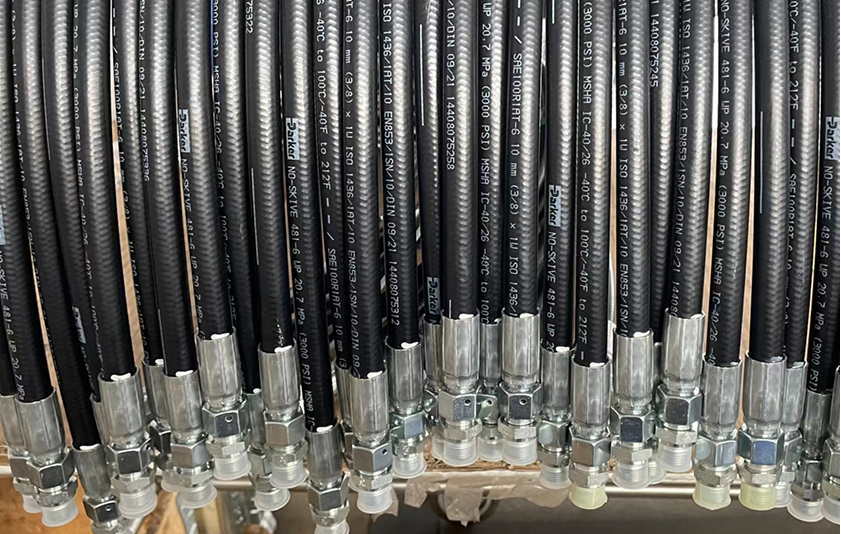
Hydraulic hoses are commonly used in hydraulic systems for transmission. The main steps in their manufacturing process are described below.
- Rubber Compounding: The first step in manufacturing hydraulic hoses is to mix rubber with other additives to form a rubber compound. The mixed rubber is typically nitrile rubber (NBR) or butyl rubber (BR), which have good oil resistance and abrasion resistance.
- Rubber Extrusion: The compounded rubber compound is further processed by an extruder, extruding it into a continuous rubber tubular preform. The extruder uses a rotating screw to push the rubber compound from a hopper into a cylindrical die, where pressure and heat are applied to form a continuous rubber preform.
- Steel Wire Braiding: A steel wire braid layer is mechanically applied to the outer surface of the extruded rubber preform. The steel wire braid layer is typically made of high-strength steel wire to increase the hose’s strength and pressure resistance.
- Inner Rubber Layer Injection Molding: An inner rubber layer is injection molded into the steel wire braided layer using an injection molding machine, forming the inner rubber layer. This inner rubber layer typically uses a rubber material with good oil resistance, such as nitrile rubber.
- Sealing and Cutting: Both ends of the rubber hose are sealed to ensure no leakage of the internal liquid. The hose is then cut to the required length using a cutting machine.
- Hose Assembly: According to usage requirements, hose connectors (such as fittings, joints, flanges, etc.) are assembled onto both ends of the hose for connection to the hydraulic system.
- Quality Inspection and Packaging: The manufactured hose undergoes quality inspection, including visual inspection and pressure testing, to ensure that the hose meets standard requirements. The hose is then packaged and labeled with relevant product information and quality certifications.