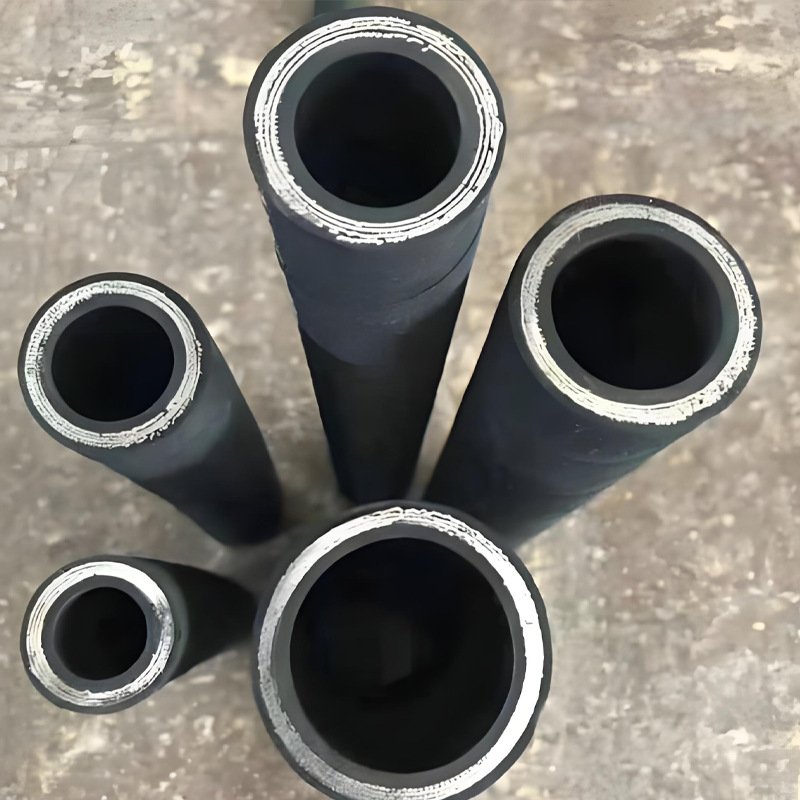
Within the EN853 standard’s hydraulic tubing family, 1SN and 2SN are most frequently compared due to their wide range of applications. Although both belong to the wire braided series, there are clear distinctions between them in terms of performance, cost, and applicable fields. This article will provide an in-depth comparison to offer you a clear basis for selection.
Differences in Structural Design and Pressure Bearing Capacity:
1SN hydraulic hoses use a single layer of high-strength steel wire braid as reinforcement, typically covering low to medium pressure ranges. 2SN hydraulic hoses, building upon 1SN, add a second layer of steel wire braid, making them more robust and capable of withstanding significantly higher system pressures. Specific data (source: based on EN853 standard pressure rating table) shows that, for the same inner diameter of 16mm, the typical working pressure of a 1SN hose is approximately 25 MPa, while a 2SN hose can reach approximately 35 MPa or higher. The burst pressure of 2SN is also significantly higher than that of 1SN.
Flexibility and Bending Radius: Due to the absence of a single layer of steel wire braid, 1SN hoses are generally more flexible than 2SN hoses, with a smaller minimum bending radius. This characteristic gives 1SN a natural advantage in applications with limited space and where small-radius bends are required, such as complex wiring within equipment or hydraulic drives for robotic arms. While 2SN also possesses good flexibility, it requires more space for bending at the same diameter.
Pulse Fatigue Performance
Pulse fatigue performance refers to the service life of a hose under repeated pressure fluctuations. The two-layer braided structure of 2SN hoses provides better fatigue resistance, enabling them to withstand more frequent and greater pressure changes. Therefore, in pipe sections with severe pressure fluctuations, such as near hydraulic pump outlets and directional valves, 2SN or higher-grade hoses must be preferred.
Cost and Economic Benefits
From a manufacturing cost perspective, 1SN hoses are generally cheaper than 2SN hoses due to their relatively simpler materials and manufacturing processes. Under the premise of meeting system pressure requirements, using 1SN hoses in low-pressure stable conditions such as low-pressure return lines and pilot control lines can effectively control overall costs and achieve optimal economic efficiency.
Selection Summary:
Scenarios for choosing 1SN: Low-pressure systems (such as return and drain lines), compact spaces requiring extremely high flexibility, and operating conditions with stable pressure and no impact.
Scenarios for choosing 2SN: Medium- and high-pressure main systems, operating conditions with pressure fluctuations or slight impacts, and critical pipelines requiring a higher safety margin.
In short, the 2SN should not be simply considered an “upgraded version” of the 1SN, but rather as a “dedicated solution” for different operating conditions. The correct choice stems from a comprehensive consideration of system operating pressure, dynamic characteristics, and installation space.